






October 15, 2026
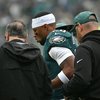
The Philadelphia Eagles announced on Thursday Jalen Hurts will not play on Sunday against the Carolina Panthers, due to a "superficial blood clot" in his calf.
What is a superficial blood clot, and what does that mean for Hurts the rest of this season and going forward?
We chatted with Dr. Dinesh Dhanaraj, attending orthopedic surgeon at St. Mary Medical Center in Langhorne, who offered us some insight on this type of injury, and what can be expected going forward. A note before getting started...
The views and opinions expressed in this article are those of the author and guest authors and do not reflect any official policy or position of any NFL team or a team's athletic physicians.
Hurts said that he had been "cleated" during the Eagles' loss to the Rams Week 4. In case you don't know what "cleated" means, another player's cleat dug into Hurts' calf at some point during the game.
Before Dr. Dhanaraj even knew that Hurts had been cleated, he said of superficial blood clots, "Those can be from a bad contusion." After I debriefed Dr. Dhanaraj on the Eagles' statement, he expanded.
"So that superficial thrombophleoblitis, or blood clot, it can be from, exactly, he got cleated. There could be some bleeding in a smaller vein and it forms a clot, just like it's supposed to. Those aren't as dangerous, because they're superficial and they can resolve and get reabsorbed. The deep vein thrombosis, the "DVT," are the ones that are dangerous because those will go all the way to the heart and they can cause a pulmonary embolism.
"So that's why with the superficial ones, they're not dangerous, but if they start to move or start to become bigger, they can pose a problem.
"So hypothetically, I guess they're keeping him out so it doesn't get injured, doesn't move further. Sometimes blood thinners are involved to treat these. And it's hard to say for how long, the superficial ones, to break them up, they just recommend warm compresses and just basically gentle supportive care, trying to avoid major blows to the area, or significant activity. But usually it's just self limiting.
"It's probably going to be week by week. They'll have to check that blood clot with another ultrasound to see if it's moving, to see if it's improving. If it's not moving and it is improving, it starts to stabilize and resolve, he probably can play. But if it's getting bigger or moving, then you start worrying about it going to the deep veins versus the superficial veins, and then eventually causing a deep vein thrombosis. Then you can have big problems with that if it gets thrown to the heart it blocks the lungs it's called a pulmonary embolism, which can be life threatening.
"I'm not a vascular surgeon. That's more of their specific field. But in terms of what I know in general is that if that clot starts to improve, whether it goes away, it gets reabsorbed or if it gets very stabilized — like it's not moving or if it's not getting larger — then hypothetically he can play, because he was playing on it and so they determined that he was safe to play. It's a judgment call. But that's what you would have to see, that the clot itself doesn't get worse or continue to migrate."
Follow Jimmy & PhillyVoice on Twitter: @JimmyKempski | thePhillyVoice
Like us on Facebook: PhillyVoice Sports
Add Jimmy's RSS feed to your feed reader